Who Was René Lalique? His Life and Most Famous Works

Key Takeaways
- The René Lalique phenomenon: how his life path and personal drama shaped the worldview of the great master.
- Evolution of a genius, from avant-garde jewelry art to a monumental revolution in glassmaking.
- The unique nature of Lalique glass and a look at the legendary masterpieces that captivated the world.
The Great Name
For many of our clients, the desire to buy a Lalique crystal vase or centerpiece begins with the idea of adding a truly iconic piece to their home interior. Still, few fully appreciate the deep intrinsic value of each piece or what justifies its premium cost.
Who was René Lalique?
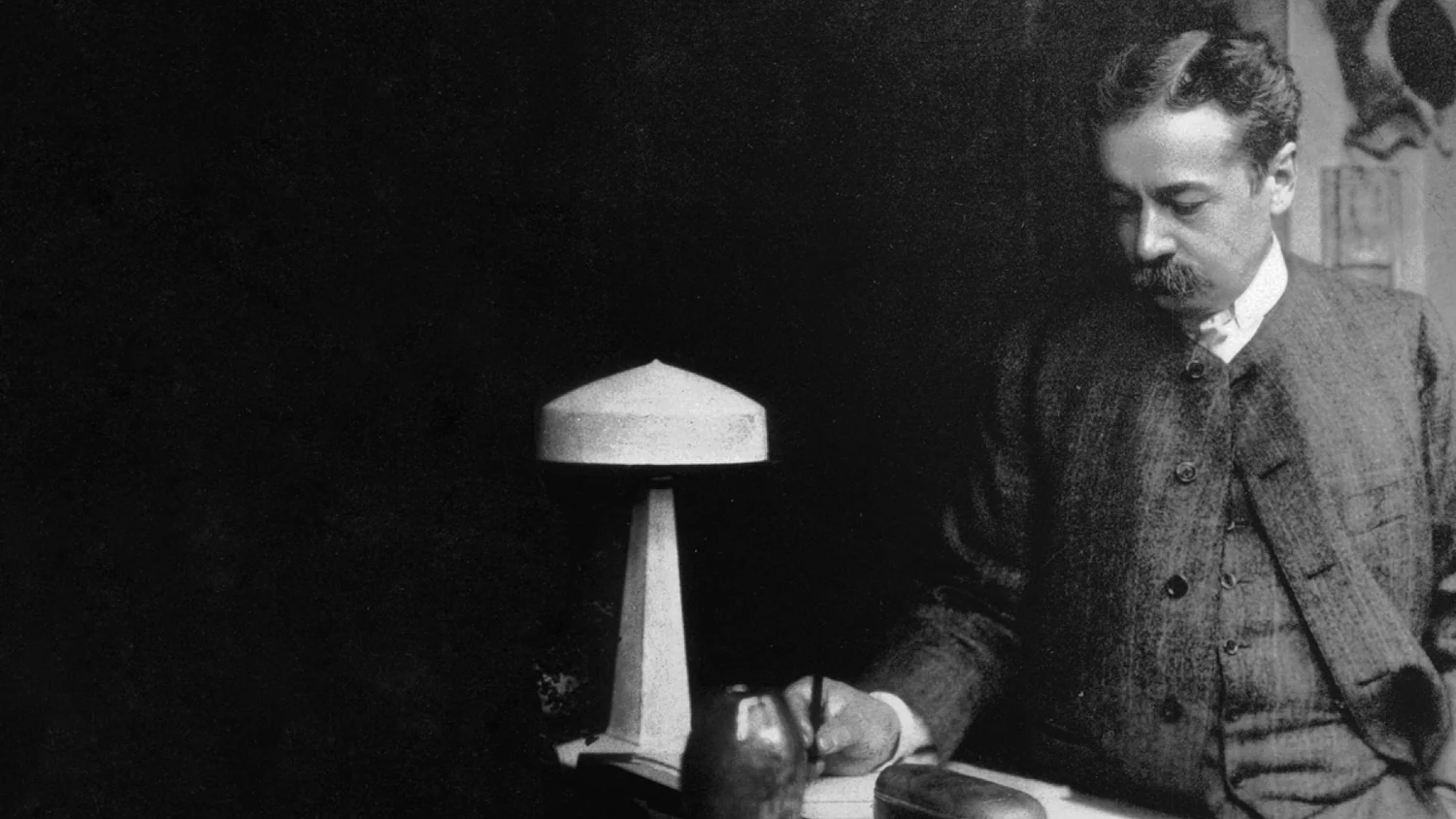
René Lalique (1860–1945) was born into a modest family in the Champagne village of Ay and lost his father at a young age. Despite these humble beginnings, he went on to become an icon of both Art Nouveau and Art Deco, living through changing eras, two devastating world wars, and a profound transformation of Europe while building a world-renowned brand and a lasting creative dynasty.
When he was just sixteen, young René started as an apprentice for Parisian jeweler Louis Aucoc. Alongside learning intricate jewelry crafting techniques, he pursued studies in academic drawing at the Paris School of Decorative Arts with great dedication.
Rather than remain confined to dusty workshops, he sought inspiration in the forests and fields, carefully sketching the complicated forms of plants and insects.
This distinctive blend of academic training and a profound love of naturalism turned a humble apprentice into a leading designer and sketch artist for Paris’s most prestigious jewelry houses. But after winning recognition, jeweler took an unexpected new direction, moving away from precious gemstones and toward crystal and glass, where he began experimenting with volume, texture, and light in entirely new ways.
The master’s inner world was shaped both by his work and by powerful personal experiences. The painful end of his early, loveless marriage to Marie-Louise Lambert caused significant emotional strain. His relationship with the young sculptor Augustine Ledru brought its own challenges, becoming a source of public disapproval and judgment because of their considerable age difference and the social conventions they defied.
However, it was Augustine who became his true muse and second wife. Fate subjected their union to a cruel test: the loss of their child in infancy, which forever gave René’s worldview a profound sense of drama. And yet, this marriage gave the artist Suzanne and Marc, who joined their father’s work and became key figures in carrying forward his artistic vision and the philosophy of the Lalique brand.
The Art Nouveau Jewelry
Following his studies in Paris and England, René began selling his designs to established jewelry houses as an independent artist. Surprisingly, his concepts quickly earned traction with top brands such as Jacquot, Cartier, and Boucheron. Realizing that traditional jewelry had become too focused on the conventional display of wealth, the designer acquired his own workshop on Place Gaillon in Paris and began creating a revolution through his bold and original creations. Lalique moved away from traditional gemstones, working instead with organic materials and minerals such as horn, bone, enamel, and semiprecious stones.
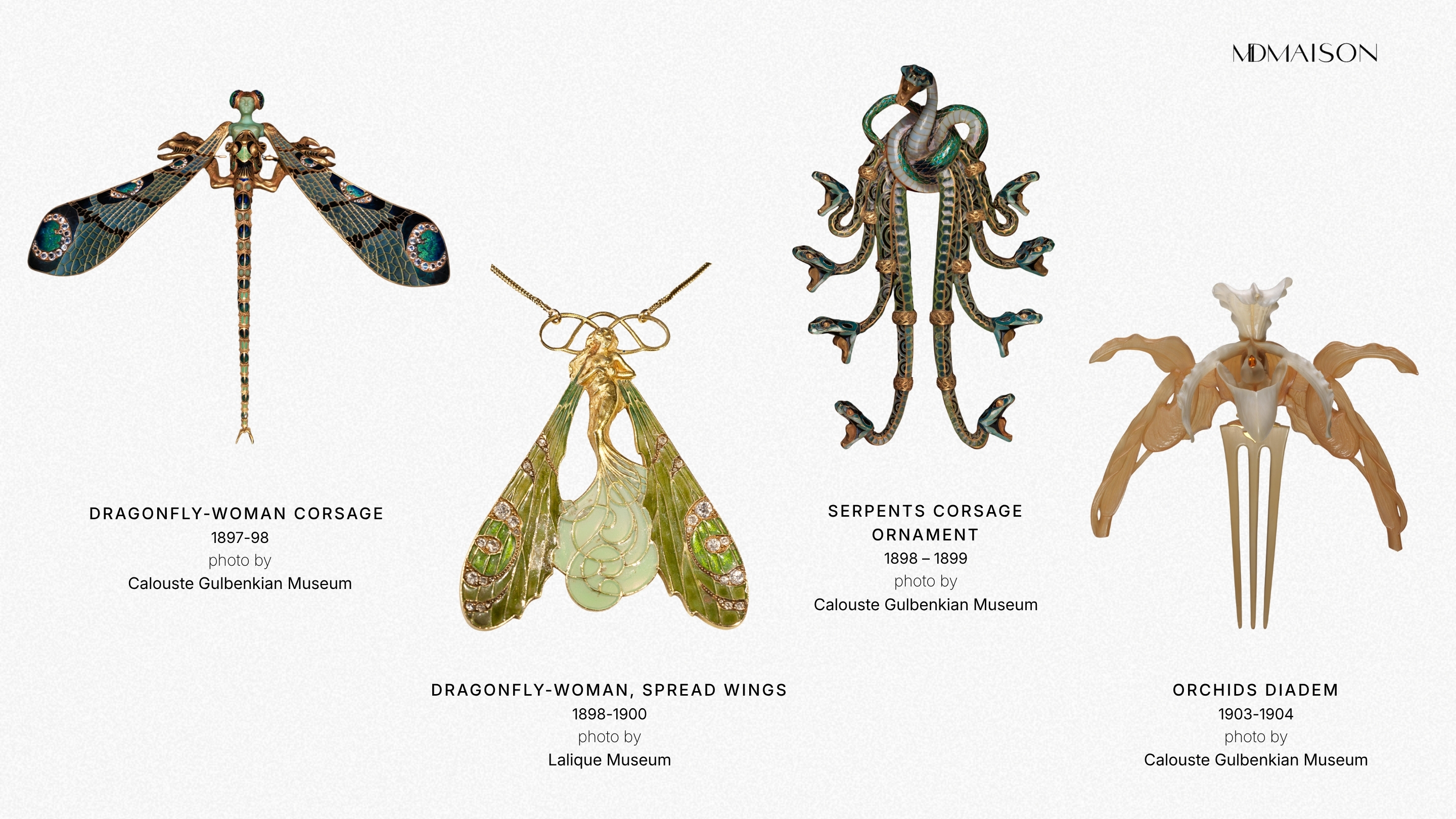
Among the most famous jewelry creations are:
- Dragonfly Woman corsage (1898): A flagship Art Nouveau design presented at the 1900 World's Fair, a mythological hybrid of a woman and a predatory insect, with the dragonfly gripping.
- Nine Snakes (1900): An expressive brooch-necklace featuring nine intertwined, scaled snakes made of gold and iridescent enamel.
- Swallows Hair Comb (1899): An elegant hair accessory with enameled glass birds depicted in flight against a natural horn structure.
- Woman with Butterflies pendant (1900): A poetic composition combining a female profile carved from stone with translucent wings made using the intricate plique-à-jour enamel technique.
- Orchids tiara (1904): A striking example of unconventional materials, with orchids carved from horn and ivory and delicate dewdrops represented by transparent topaz set in gold.
At the height of his success, the artist reached an important creative turning point. He had pushed his jewelry work to its limits, while countless imitators were making his distinctive style less unique through endless copies. Instead of staying within those boundaries, René chose to leave jewelry behind and apply his Art Nouveau and Art Deco experience to a new artistic medium with greater potential.
The Artistic Glass
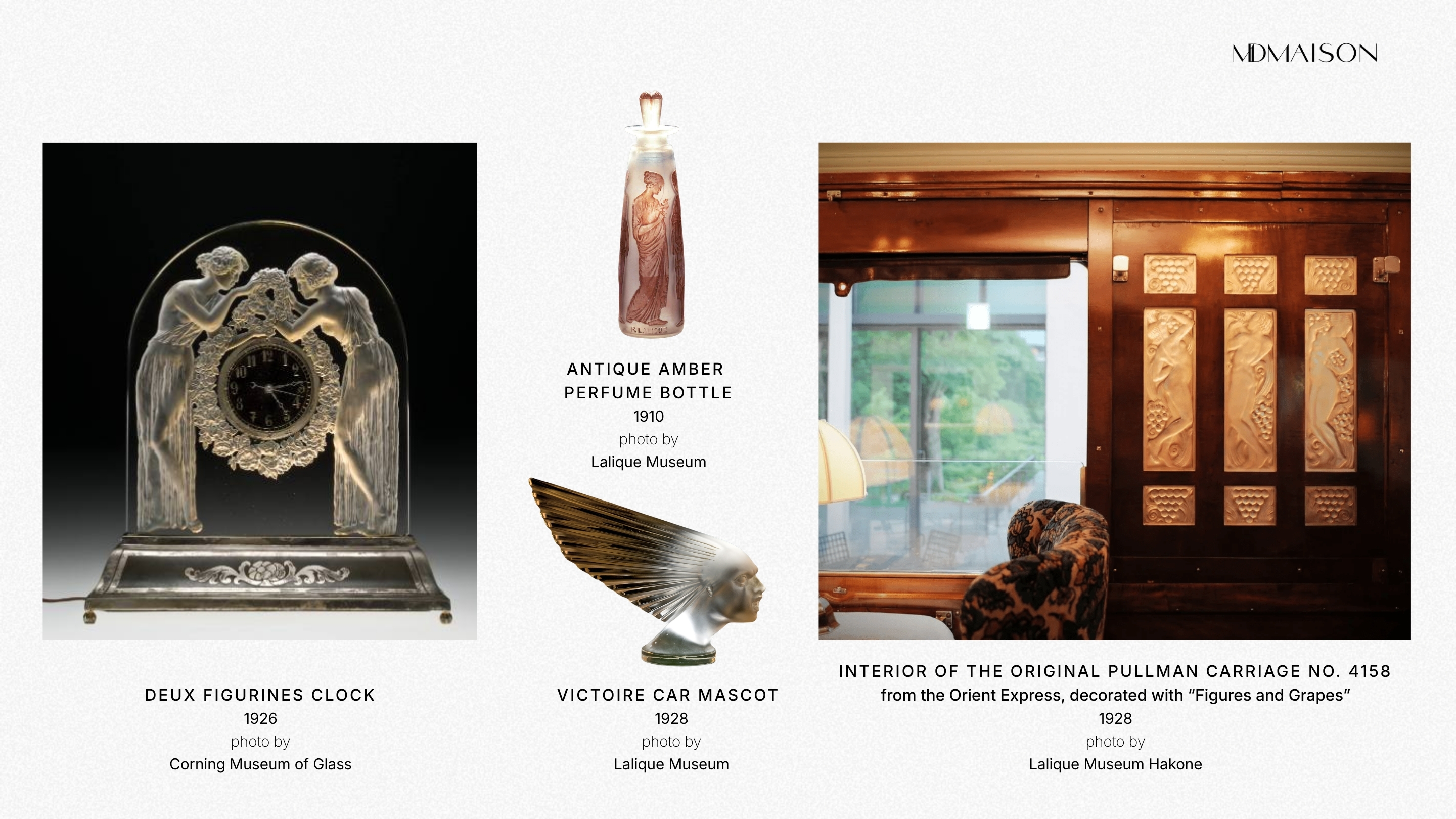
The glassmaking story began with a brilliant collaboration with perfumer François Coty, who was looking for beautiful packaging for his fragrances. Replacing standard, medical-style bottles, René Lalique created decorative flasks that established the perfume bottle as a luxury item. When the project proved successful, he bought and modernized a factory in Alsace. He used the facility to refine pressure-molding techniques and develop the signature opalescent and frosted glass, recognized for its velvety relief and soft, deep light refraction that created a distinct high-end look. This expanded production allowed the company to manufacture everything from fine vases and sculptures to iconic hood ornaments for Rolls-Royce and Bentley.
The war years forced the company to temporarily change course: the enterprise adapted to meet pharmacy and medical needs. In May 1945, just after the liberation of Paris, René Lalique passed away.
Leadership immediately passed to his son Marc, a visionary executive who went far beyond managing a family legacy. Together with Suzanne, they managed to accomplish what seemed impossible: fully restore the brand’s former glory and bring production back to its previous capacity. Then came another transformative decision — the factories moved from ordinary glass to premium crystal, taking the brand into an entirely new league. The creator’s heirs not only kept the company afloat but also secured the status as a global icon of luxury.
Crystal Glassware Masterpieces By René Lalique
René Lalique's glass heritage is still the gold standard for French decorative arts. Today, the House honors this tradition by reviving legendary pieces directly from the original drawings and molds. For collectors, these reissues offer the possibility to acquire legendary Art Nouveau and Art Deco masterpieces with an exceptional degree of authenticity.
- Victoire figurine (1928): An expressive female head with dramatic, swept-back hair, originally designed as a hood ornament for automobiles.
- Chrysis (1931): A curving female figure with her head thrown back, sculpted from satin-finished crystal.
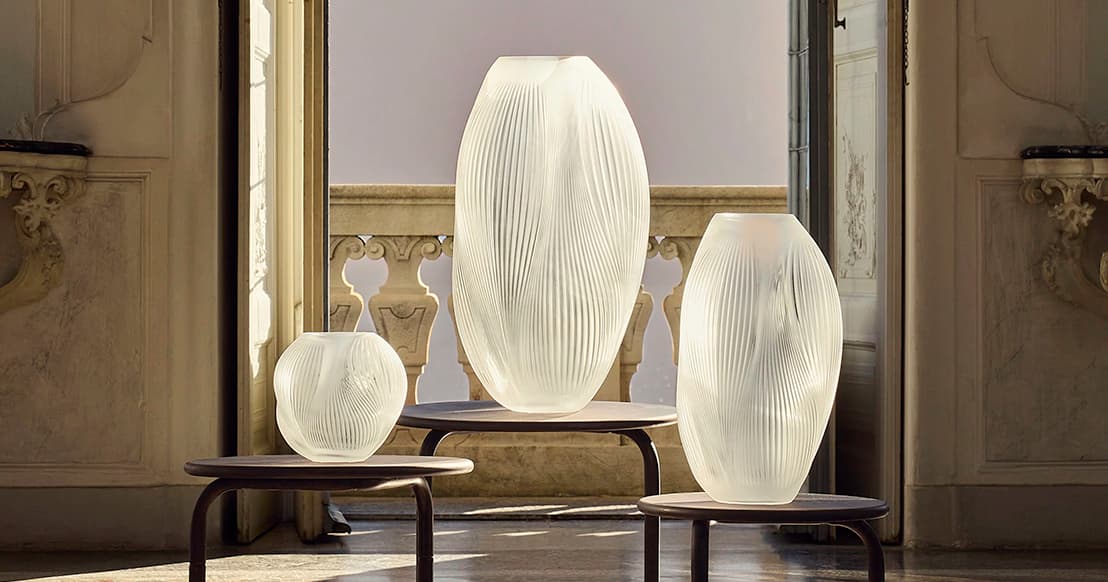
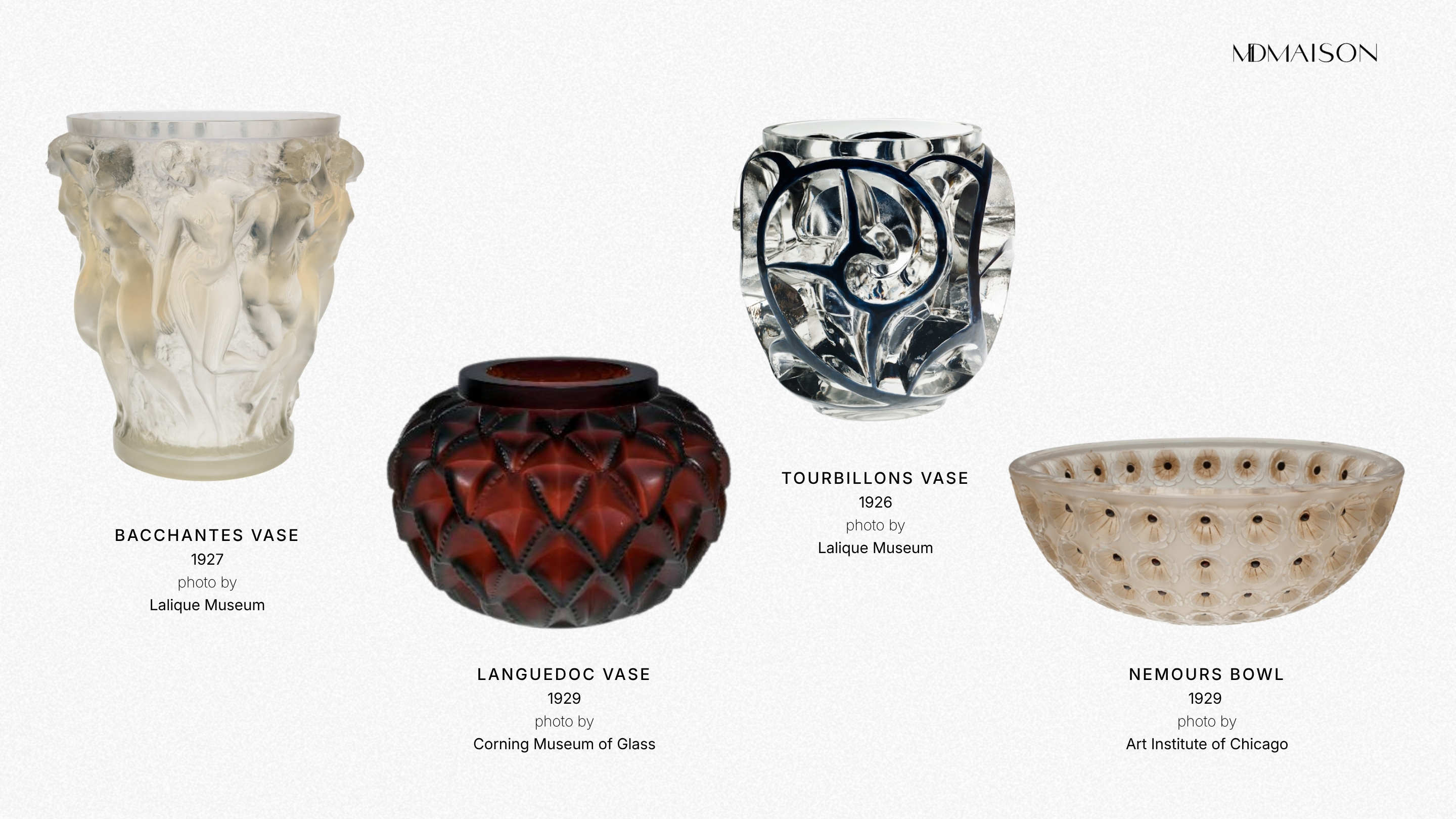
- Tourbillons vase (1926): The legendary swirl vase with raw, geometric swirls that still feels incredibly futuristic even today.
- Bacchantes vase (1927): The brand's signature bestseller, decorated with a relief ring of frosted, dancing Bacchus priestesses.
- Languedoc vase (1929): A statement satin-crystal item textured with a bold pattern of intertwined cactus leaves.
- Nemours Bowl (1929): A legendary deep bowl adorned with transparent, raised cabochons that spread outward from the center like poppy petals.
- Poisson (1913): The iconic Lalique crystal fish sculpture is one of the most popular starting points for a personal collection of decorative elements.
Modern Continuation Of Glassmaking
Few family stories show such a seamless transfer of artistic vision and skill across generations as the Lalique dynasty.
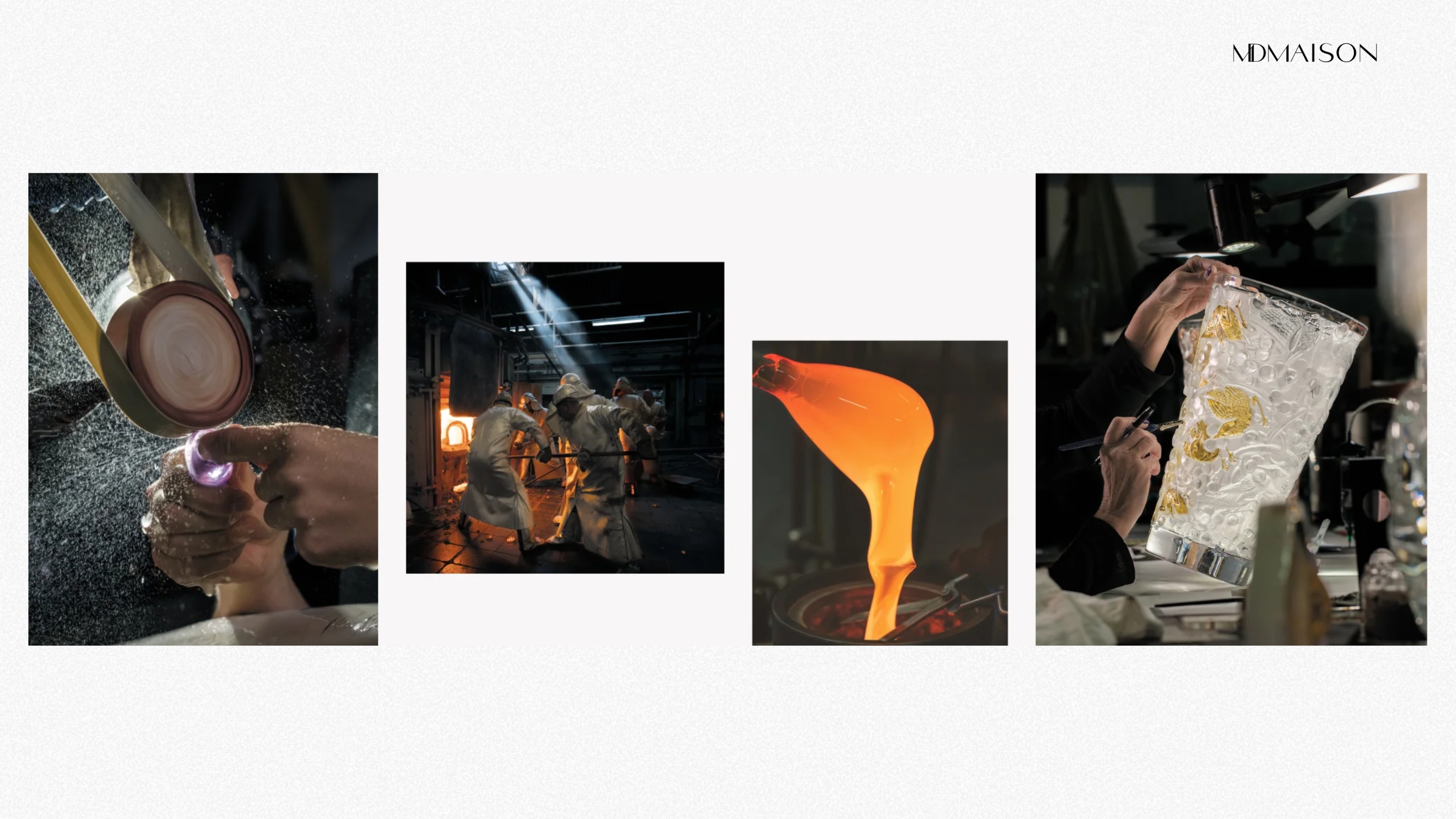
All the glass products are still created at the legendary factory in Wingen-sur-Moder, which has been operating without interruption since 1921. Here, authentic manual processes are maintained by true masters of the trade holding the title Meilleurs Ouvriers de France. The combination of centuries of expertise and modern technology gives the manufactura the freedom to bring its most ambitious designs to life.
The new collections released after the master’s death are no less impressive. You can judge for yourself:
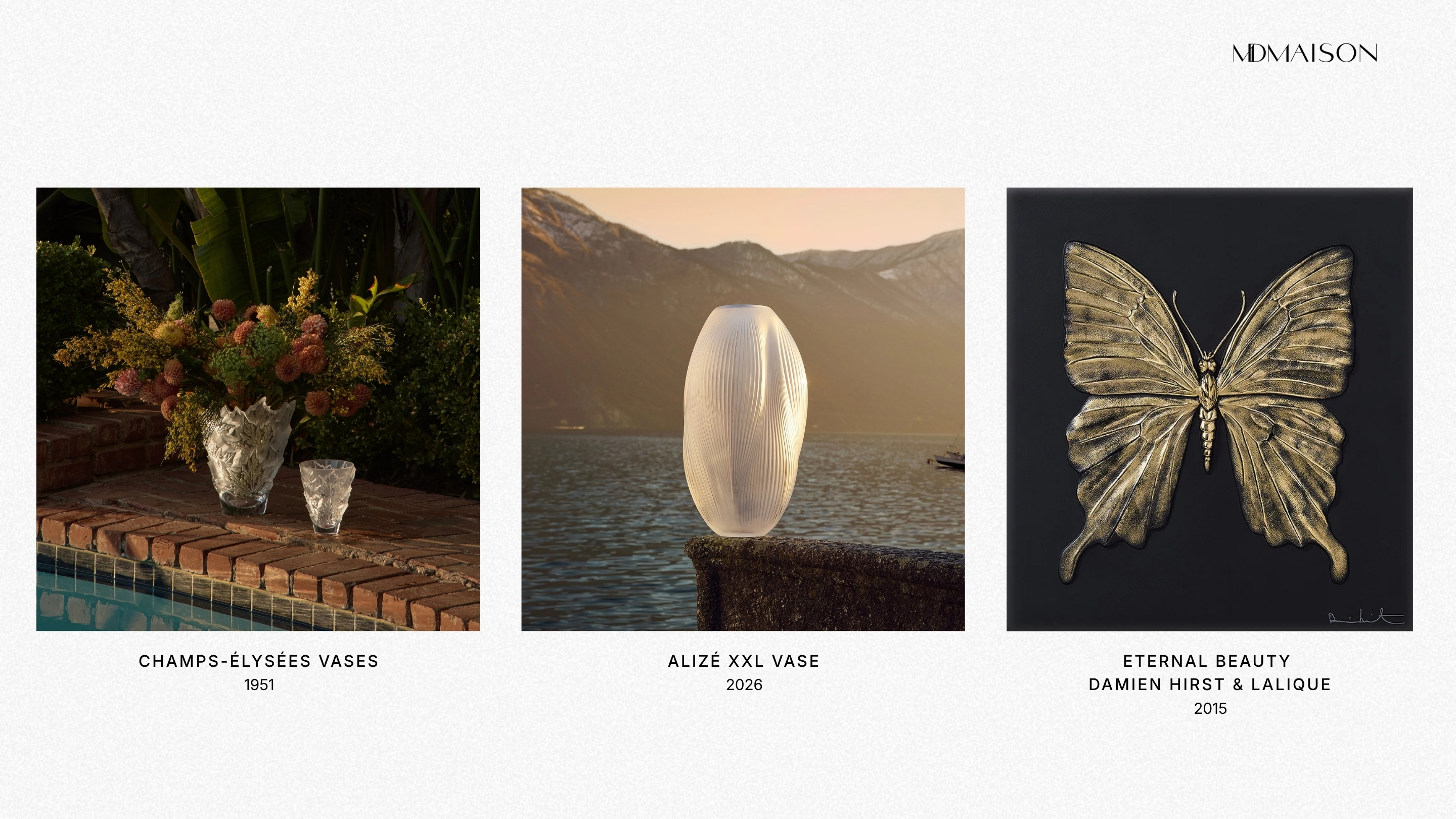
- Champs-Élysées Vase (1951): A heavy, showstopping oak-leaf bowl by Marc Lalique, built for high-end spaces.
- Zeila Panther Sculpture (1989): A legendary panther by Marie-Claude Lalique, René’s granddaughter, captured in a powerful pose just before it leaps.
- Piou-Piou Lalique Crystal Birds Figurine (2026): A delicate crystal bird from the latest lineup. A top pick for desk accessories or a memorable premium gift.
- Alizé Vase (2026): A sleek contemporary vase defined by fluid, wave-like curves that suggest a soft movement of air.
- Single Malt Dragon Whiskey Decanter (2009): A luxurious collectible decanter decorated with a monumental bas-relief of a mythical dragon.
- Zaha Hadid Manifesto / Visio Vase (2014): A futuristic work created in collaboration with legendary architect Zaha Hadid.
- Eternal Beauty art panel (2015): A rare collectible featuring crystal butterflies sealed in transparent blocks, from the limited-run Damien Hirst collaboration.
A New Chapter
In 2008, the Swiss group Art & Fragrance, led by Silvio Denz, bought manufactura, saving it from a crisis. The new owner invested in developing production in Alsace and scaled its popularity around the world. In 2011, the brand launched its interior design line, Lalique Maison, introducing furniture, textiles, and accessories decorated with its recognizable Art Deco motifs. It also created a separate direction, Lalique Art, to design striking art objects in collaboration with contemporary artists and foundations.
The following year, the corporation announced a full return to its founder’s jewelry roots. The House launched its High Jewelry division, giving René Lalique’s heritage a contemporary understanding. Its portfolio also grew to include restaurants, hotels, and villas, helping bring the name to new audiences.
In 2018, the label celebrated 130 years of creative freedom, masterful craftsmanship, and the unmistakable spirit of French Art de Vivre. Today, Lalique is an entire creative universe that goes far beyond crystal, encompassing furniture, lighting, jewelry, and fragrance — all still brought to life exclusively in France.
The Legacy We Still Cherish Today
René Lalique had an extraordinary gift for seeing sacred poetry in the most delicate forms of nature and matter. The contemporary factory carefully preserves that creative spark to this day. Every new release serves as a tribute to the memory of the great master.
These pieces should never be about simply following a trend, but a tool to create a story, leave something meaningful behind, and give the space a deeper sense of character.
Our MDMAISON team has solid experience working with projects where Lalique glass creations are integrated into interiors. With a deep understanding of their artistic value, we know how to showcase these collectible pieces in contemporary settings.
Reach out to us to handle the full scope — from selecting the right design to shipping and final interior placement. Contact us today to bring your concept to life smoothly.